
This blog offers my own analysis of the impacts of the latest budget from a policy perspective. For those interested in a theological analysis on the modern case for aid, I encourage you to read Tim Costello’s ‘A Theological Reflection on the Current Need for Australian Aid’.
At a time of rising global conflict, deepening humanitarian need, and widespread cuts to international aid, Australia’s decision to hold the line on aid matters. Across the world, major donors are scaling back their commitments to humanitarian assistance, even as crises intensify and millions more people are pushed into vulnerability. In this context, the Albanese Government’s choice to maintain aid sends an important signal to our region, to our partners, and to vulnerable communities, that Australia recognises the role aid plays in strengthening communities, stability, and prosperity.
However, while this commitment is welcome, the 2026–27 Budget also reveals a more complex picture: without sustained action, Australia risks quietly falling behind at precisely the moment when aid is needed most.
2026-2027 Budget in Real Terms.
The 2026-2027 Federal Budget increased aid to $5.209 billion from $5.09 billion, a nominal increase of $112 million. This increase means that the government has fulfilled its promise to increase the aid budget by 2.5% annually from 2026-27 onwards.
However, when the new budget is adjusted for inflation, it becomes clear that the aid budget is decreasing. Further, when placed in the context of the overall Federal Budget, aid falls from 0.65% to 0.63%. This means that on its current trajectory, aid will continue to fall to 0.58% of the Federal Budget by 2029-30.
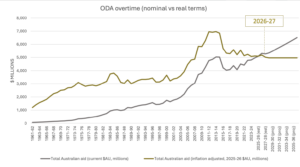
(ACFID – 2026-2027 Federal Budget Analysis)
When the 2026-2027 aid budget is broken down by region, there has been an appreciated increase to aid in the Pacific and Southeast Asia, to help support our region and the ongoing crisis in Myanmar. However, funding to the Middle East and Africa is decreasing by 5.685% from $153.3 million to $144.6 million, even as these regions continue to face significant humanitarian and health crises.
This projected decline in aid is also reflected when aid is expressed as a percentage of GNI. Before the 2026-27 budget, Australia contributed just 0.18% of GNI to aid, ranking 24th of 33 DAC donors, well below comparable countries. After the 2026-2027 budget, the percentage has dropped to 0.17% and will continue to fall to an estimated 0.14% by 2036-37. (Australian Aid Tracker)
While the Albanese Government’s decision to maintain and modestly increase aid is welcome, these figures show that Australia’s aid effort continues to decline relative to the size of both the economy and the Federal Budget. The significance of this becomes clearer when viewed against the current global context.
Human cost to cutting aid
There is a clear global trend of cutting aid, and it is occurring at a time of rising conflict and uncertainty, with 59 active conflicts across 35 countries, leaving one in seven people worldwide under the threat of armed violence and 239 million in need of life-saving humanitarian assistance (Global Peace Index). New research showcases the human cost of cutting aid, estimating that reductions could result in “more than 11.5 million preventable deaths by the end of the decade.” These reports highlight and recognise that substantial cuts, particularly by the United States and Europe, demonstrate a shift towards a “new normal of significantly reduced international engagement – not as a temporary adjustment but as a structural realignment.” These reports further emphasise that aid cuts of this proportion “are not technical adjustments but political choices with lasting consequences.”
While some are calling for Australia to follow this global trend, it is important to recognise that Australia has already significantly reduced its aid program over the past decade. The 2013 integration of AusAID into DFAT marked one of the most substantial reforms to Australia’s aid structure and was accompanied by the largest aid cuts in the country’s history. In doing so, the restructuring initiated a long-term reduction in aid’s share of the Federal Budget, resulting in a significantly reduced aid program even before the current global withdrawal from aid started.
Aid is prevention
Within this global context, it is crucial to understand that aid is not merely a response mechanism, charity or a tool for international engagement. At its core, aid is prevention. By strengthening health systems, supporting education and food security, building resilience to disasters, and helping communities withstand shocks, aid reduces the risk of crises escalating into conflict, displacement, instability, and humanitarian emergencies. Aid saves lives, helps stabilise vulnerable neighbours, and contributes to a safer and more secure region for everyone. It is not charity; it is a practical investment in regional stability and Australia’s security. As the effects of global crises are increasingly felt at home, maintaining this investment has never been more important. The devastating human consequences of recent global aid cuts are already becoming unmistakably clear.
Case study: Ebola outbreak
The ongoing Ebola outbreak in the Democratic Republic of the Congo (DRC) offers a stark example of the importance of aid as prevention, highlighting the consequences of global reductions in aid. Between 2024 and 2026, USAID funding to the DRC fell by $1.379 billion, dropping from $1.4 billion to just $21 million. These cuts have crippled the DRC’s capacity to respond to the current Ebola outbreak, particularly reducing its ability to detect and contain the virus early. Consequently, more than 360 people have already died, and over 1274 confirmed cases, a number expected to increase significantly in the coming weeks. (CDC, Ebola)
This crisis demonstrates that USAID could have acted as a critical prevention measure to reduce the impact of the current outbreak. In previous Ebola responses, USAID “coordinated the practical aspects of a response, trained health workers, facilitated contact tracing, boosted testing capacity and provided resources for safe burials” and “would have moved stockpiles of personal protective equipment that it maintained within hours.” Yet now there is a backlog for any protective equipment, and health care professionals are risking their lives trying to control this outbreak without adequate protection.
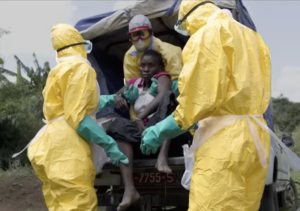

The importance of aid as prevention is a critical element of this crisis, with specialists stating that “It is far cheaper and easier to prevent and contain outbreaks than it is to respond to them…With the US cutting off the first option, the second scenario will become increasingly common.”
This crisis highlights the preventable human cost of global aid cuts, while also demonstrating that such crises carry far-reaching consequences, as “outbreaks like these have economic, geopolitical and global stability implications.” It demonstrates the need for the Albanese Government to strengthen its commitment to Australian aid, as it is an investment in global security and stability and prevents similar crises from recurring.
The current outbreak also highlights why, as Christians, we are called to advocate for preventing crises like this, as “allowing anyone to die needlessly of a disease that can be stopped is immoral, and we are living in a world where we don’t have to allow infectious diseases to spread unchecked.”
Defence vs Aid Trend
Whilst aid is being cut globally, the rate of defence spending continues to grow significantly both in Australia and globally. This partly reflects a common argument that rising global instability requires a stronger financial commitment to defence. Australia already spends around ten times more on defence than on aid, one of the widest gaps in the developed world. During the Cold War, this ratio averaged closer to 8:1. Yet today, for every $100 of Federal Budget spending, around $7.14 goes to defence, compared with just $0.63 for aid. (Australian Aid Tracker)
This imbalance is set to grow. Defence spending is projected to increase by an additional $53 billion over the next decade and to reach around 3% of GDP by 2033. Under the current framework, this would widen the defence‑to‑aid ratio to around 13:1, rising to 16:1 if defence reaches 2.5% of GDP, and to 19:1 if it reaches 3%. (Devpolicy Blog, 2025)
This trend is reflected globally, with military spending increasing 41% in the last 10 years to a now US$2.9 trillion (AUD $4 trillion). A point further articulated by the UN Secretary-General Antonio Guterres when he noted in his 2024 New York address that “global military spending in 2024 was 13 times more than all development aid, equivalent to the entire Gross Domestic Product of Africa”.
These figures reflect a broader global failure to invest in aid as a preventative tool, instead, it is treated as primarily a reactive response mechanism to developing crises. Yet it is clear that maintaining a modest but effective aid program is essential to a balanced security strategy. Defence responds to immediate threats; but aid reduces the conditions in which those threats emerge. Reducing aid in the future would not strengthen Australia’s security posture; it would weaken it.
Australians Support Aid When They Understand the Facts
Despite global pressure for Australia to follow the global trend and further cut aid into the future, this position is not reflected in domestic attitudes, with new national polling showing strong and consistent support for Australian aid with:
- 74% of Australians support aid being maintained or increased
- 79% support aid to respond to disasters and reduce poverty in our region
- 68% recognise aid contributes to regional security and stability
- 75% agree aid helps Australia build relationships in an uncertain world
The case for protecting Australian aid is further strengthened by polling that shows Australians significantly overestimate how much is spent on aid. Around 80% believe aid accounts for more than 1% of the federal budget, with 20% estimating it exceeds 5%. (YouGov, April 2026)
Evidence also shows that support increases when these misconceptions are addressed. Research by the ANU Development Policy Centre found that informing Australians about the scale of global aid cuts increases support for aid by a further eight percentage points
RedBridge focus groups reinforce this finding, showing that framing aid as “less than 1% of the Budget – with 99% still spent at home” reassures voters that aid does not come at the expense of domestic priorities and maintains support across a wide range of voter groups.
Together, this research suggests that Australians are not hostile to aid. Rather, support strengthens when people understand both how little Australia currently spends and the role aid plays in creating a safer, more stable world.
At a time when global aid is declining, and defence spending continues to rise, it is important that Australia continues to protect its aid program. Aid is not charity; it is a practical and proven tool of prevention that saves lives, reduces instability, and supports a more secure and resilient region. The 2026-27 budget provides important protection, but forward projections show that without further growth, Australia’s aid effort will continue to decline relative to the size of the economy and the Federal Budget.
Encouragingly, Australians recognise the value of aid and support maintaining – and in many cases increasing – Australia’s contribution. At a time of growing global uncertainty, Australia has an opportunity to build on the progress made in recent years and continue to rebuild its aid program. Restoring aid to 1% of the Federal Budget would represent a modest and achievable step towards ensuring Australia continues to play a meaningful role in building a safer world for all.
For a deeper analysis of the case for Australian aid, including further evidence and real-world case studies demonstrating the tangible impact of aid, see The Modern Case for Aid.